
I’m approaching my first-year anniversary working as the Horticultural Therapist at Homewood Ravensview. At Ravensview, we are very fortunate to be located on 28 acres of forested hillside. The area is the traditional home to the WSÁNEĆ people and is referred to as ȽÁU,WELṈEW̱/John Dean Park. One of the primary reasons I accepted the role was I saw it as an opportunity to connect others with the local land on a deeper level. Even before I worked my first shift at Ravensview, I began dreaming of building a labyrinth somewhere on the property so clients and staff could have ongoing access to a therapeutic tool for calming the mind, relaxation, restoration, and exercise outdoors.
Labyrinths are pattens that can be found around the world. The various patterns, based on principles of sacred geometry, have been passed down through the ages for at least 4,000 years. Typically, labyrinth patterns are circular, are used for walking by feet, and can be an excellent tool for meditation. By following the one path to the center, the walker can use the labyrinth to quiet their mind, find peace, and gain insight.
I understand from my many years of coaching that dreams are very different from goals. It was one thing for me to envision a labyrinth, but for it to become a reality, it would also take planning, followed by action, and definitely help from others to build it. So, I began with small steps, and in time, those small steps became the seeds for something bigger.
My first attempts at a labyrinth took shape inside Ravensview. They were created by applying masking tape in a labyrinth-like pattern to the surface of the floor in our expressive therapy studio. Next, the clients and I experimented with creating a three-circuit labyrinth beside our herb garden outdoors. Its location and size, allows clients and staff easy access to it. Deconstructing and reconstructing this labyrinth every few months has provided new clients the opportunity to be involved in the process of constructing a labyrinth too.
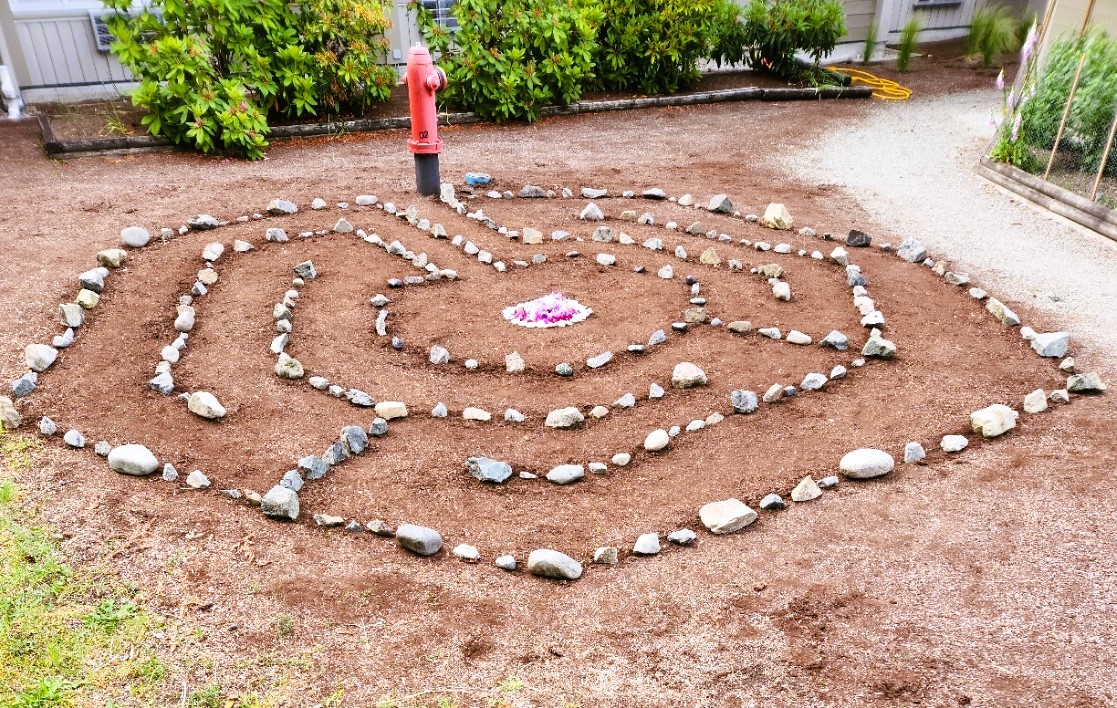
Then one day, while guiding a group of clients on a forest walk, I came upon the perfect home for a labyrinth in the forest. It is a patch of flat land, clear of trees except at the perimeters where there are majestic cedar, Douglas-fir, and maple trees. In March this year, the clients and I began collecting rocks during our walks, and laying them to create a spiral labyrinth pattern. Over the next five months, we collected many more rocks, adding them to our growing spiral. Eventually, we decided to change the spiral labyrinth pattern to something more classical, expanding its size, and including more traditional back and forth turns. The turns are important because they are metaphors for the highs and lows, the joys and sorrows one experiences throughout a lifetime.
The labyrinth in the forest is now complete and is being well-used. It includes 12 turns. I haven’t counted how many rocks it contains. The plan is for each new client who comes to Ravensview, to add a rock to the forest labyrinth pattern, so they too will become part of its legacy. Other than that, our intention is to leave it as it is, and continue to walk the labyrinth while witnessing the natural changes the seasons will provide. Several times a week, I offer a guided forest labyrinth walk as part of our regular Horticultural Therapy programming for clients. It’s not just the clients and I though who have been using this labyrinth. I have noticed my colleagues heading down to walk it too. I am very proud to share with you this story, these photos, and that my dream of creating a labyrinth at Homewood Ravensview has become a goal achieved. It’s a great example to remind me any dream can become a goal achieved with hope, planning, action, the help of others, and believing in the potential of a community working together.


 Cliff Thorbes, HTR, CCDP®